

Thanks to everyone who joined us for our October Hardware Innovators Monthly Webinar: Build Your 4-Person B2B Team.
Whether you attended live or couldn’t make it, we’ve got you covered. Below, we’re recapping the biggest takeaways from Rand’s session, including how to identify gaps in your B2B sales process, assign clear responsibilities, connect marketing and sales, and build your team around your store’s revenue opportunities.
And if you’d like to continue receiving insights, tools, and strategies built specifically for hardware retailers and lumberyards, sign up here to stay connected with future Hardware Innovators webinars and resources.
Build a System That Helps Customers Buy
Imagine your contractors getting quotes faster, existing accounts receiving consistent follow-ups, someone proactively visiting job sites, product experts helping customers solve problems, organized customer data, and marketing and sales working toward the same goals.
That’s the idea behind a Revenue Department.
In the webinar, Rand outlined how marketing, sales, operations, and data can work together to support growth. Marketing creates awareness and reasons to engage. Sales turns those opportunities into conversations, customers, and account growth. Operations delivers on the promise, and data helps the team decide what to do next.
The starting point is a shared approach: one department, one scorecard, and one revenue goal.
Free Webinar Assets
📋 30-Day B2B Super Team Challenge – your four-week action plan
Meet the Four B2B Roles
Rand introduced four specialized roles that help a store find opportunities, make purchasing easier, strengthen relationships, and grow existing accounts.
1. FIND: Business Development Coordinator
Mission: Keep new opportunities moving into the sales pipeline.
This role researches potential customers, identifies qualified prospects, organizes contact information, and helps connect opportunities with the right person on your team.
Responsibilities include:
-
Researching contractors, businesses, and target accounts.
-
Building and maintaining a prospect pipeline.
-
Qualifying inquiries and coordinating next steps.
-
Keeping contact information and outreach activity organized in the CRM.
-
Working with marketing and sales to refine targeting and messaging.
2. CONVERT: Inside Sales Rep
Mission: Make your store easy to buy from.
Inside sales helps customers move from interest to purchase through responsive communication, clear next steps, and consistent follow-up.
Responsibilities include:
-
Responding to and qualifying sales opportunities.
-
Understanding customer needs, budgets, and timelines.
-
Coordinating quotes, meetings, and next steps.
-
Following up with new prospects and existing customers.
-
Keeping account information and sales activity current.
A practical principle from the session: Every quote gets a follow-up. Every account gets a next action.
3. CONNECT: Pro Account Rep
Mission: Be where your customer works.
Your Pro customers spend much of their day outside your store. This role builds relationships through job site visits, account meetings, and conversations that help uncover upcoming needs.
Responsibilities include:
-
Building relationships with key accounts.
-
Visiting customers and job sites.
-
Sharing relevant products, solutions, and resources.
-
Tracking account needs and growth opportunities.
-
Coordinating with inside sales, marketing, and other departments.
Thoughtful route planning can help each trip serve multiple purposes, from a delivery to a customer visit or a conversation with a nearby prospect.
4. EXPAND: Product Specialist
Mission: Use expertise to grow the customer relationship.
A specialist helps customers make informed decisions while identifying additional products or categories that fit their needs. This could include paint, lumber, rental, power tools, millwork, or another area where your store has strong expertise.
Responsibilities include:
-
Identifying relevant cross-sell and upsell opportunities.
-
Educating customers on products and applications.
-
Providing demonstrations, samples, or technical support.
-
Sharing product updates and promotions.
-
Working with the broader team to support account growth.
Who Should You Hire First?
Start by asking: Where is revenue getting stuck?
Rand explained that the right first hire depends on the constraint your store needs to address.
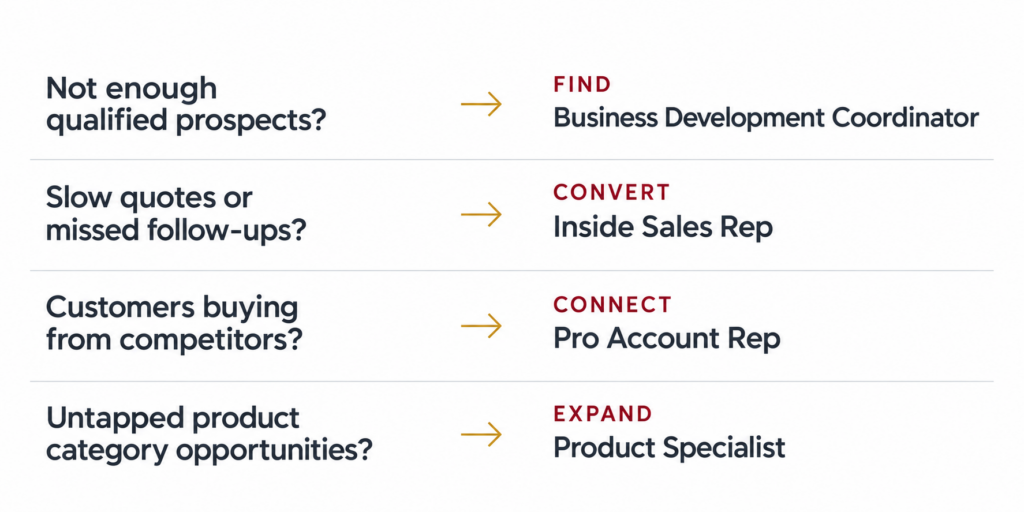
You don’t need four dedicated employees to begin. Assign the four responsibilities within your existing team, make ownership clear, and identify where additional support would have the greatest impact.
As you consider hiring, review gross profit alongside payroll and other employment costs. Revenue alone doesn’t show whether a role is financially sustainable.
Connect Marketing and Sales
Each of the four roles benefits from marketing support:
- Business Development: Reasons to reach out to potential customers.
- Pro Account Reps: Reasons to visit and reconnect with accounts.
- Inside Sales: Relevant offers and resources that support purchasing decisions.
- Product Specialists: Content that brings their expertise to more customers.
Sales conversations also give marketing useful information about customer questions, upcoming projects, and buying barriers.
A 30-minute weekly revenue huddle can help keep everyone aligned. Review the scorecard, marketing activity, pipeline, account opportunities, and the issues preventing progress.
The goal is to give the team a shared view of what needs attention and who owns the next step.
Measure What Your Team Creates
Activity matters, but it should connect to business results.
Rand’s Revenue Scorecard includes:
- B2B revenue
- Gross profit
- Active accounts
- New accounts
- Average order value
- Purchases per year
- Revenue per account
- Sales ROI
Together, these measures help your team evaluate whether its efforts are supporting more accounts, more frequent purchases, larger orders, and stronger margins.
Use the scorecard to identify the next constraint and guide decisions about processes, responsibilities, technology, and staffing.
Your 30-Day B2B Super Team Challenge
You don’t have to rebuild your entire sales operation tomorrow. Start with a focused four-week plan.
Week 1 — Measure
Build your Revenue Scorecard and establish a starting point.
Week 2 — Map
Assign someone to FIND, CONVERT, CONNECT, and EXPAND. One person may handle more than one responsibility.
Week 3 — Identify
Look for the biggest gap. Where are opportunities slowing down, follow-ups being missed, or account needs going unmet?
Week 4 — Act
Improve a process, reassign a responsibility, or evaluate a hire that addresses the biggest constraint.
Then review your progress, make adjustments, and keep building.
Missed the Webinar or Want to Revisit It?
Watch the recording, review the slide deck, and bring one question back to your team:
Where is revenue getting stuck?
Use the four-role framework to identify what’s missing and choose your next step. Build a system that helps your people support customers consistently, then grow your team as the opportunities become clear.