
January is a reset month for hardware retailers who are balancing day-to-day operations while setting the tone for the year ahead. That showed up clearly in January’s Mastermind conversations, where innovators focused less on theory and more on what worked in 2025 and what they plan to bring into the new year.
B2B reps shared concrete examples of touchpoints that turned into sales. Marketers compared what social posts actually earned attention in 2025 (and what didn’t). And General Managers talked candidly about operational resets, from delegation to building routines that support more intentional leadership.
These conversations weren’t about perfection. They were about making practical adjustments that help teams stay focused, effective, and sustainable heading into 2026. Let’s dig into the key takeaways!
Table of Contents:
B2B Mastermind Takeaways:
Takeaway #1: An Example of What the 15 Touchpoints Might Look Like for Your Store
The B2B conversation centered on one big reality: it takes more touchpoints than we think to close and keep accounts, and “touchpoints” aren’t just emails or a salesperson driving door to door. They’re the things that make your store feel unavoidable in a small market. Innovators talked about staying top-of-mind through a mix of in-person visits, contractor kits, hanging banners at jobsites, giving out breakfast burritos, and simple habit-building touchpoints that make it easy for trades to keep choosing you and leadership to hold their B2B teams accountable.
The group even mapped out a full small-town B2B flywheel featuring examples of what these 15 touchpoints should look like, with the goal of making a store the obvious default supplier for every local trade.
What made this takeaway feel real was how innovators tied touchpoints directly to recent wins. One store almost didn’t open during a blizzard, but they did, and sold a $2,500 snowblower.
Takeaway #2: The Value of the 16th Touchpoint…Timely Delivery!
A big reminder from this call was that the relationship doesn’t stop when the customer finally says “yes”, it actually starts all over again the moment you deliver.
One B2B rep shared a win where they sold roughly $1,600 worth of generators on a Monday and delivered them Tuesday morning, specifically calling out how that quick turnaround will fuel word-of-mouth. The group framed this as the “16th touchpoint”: the first touchpoint after the customer buys from you. The point wasn’t “deliver eventually.”
It was that speed and follow-through are part of what businesses are buying, and a timely delivery becomes a real differentiator when customers are juggling jobs, crews, or deadlines.
Takeaway #3: Community Partnerships Take Outside-of-the-Box Thinking
Innovators swapped a very specific example of how community partnerships can create goodwill and drive business in a way that doesn’t feel salesy. One store had donation boxes set up for a local humane society for years, but the GM was frustrated because the organization “wouldn’t buy” from them, so it felt one-sided. Then the Humane Society came back and asked how they could work together.
The store responded with a concrete structure: humane society staff could buy anything in the pet aisle at a discounted rate, and anyone who shops there and donates those same products to the shelter also gets the discount. Plus, the store offered delivery.
They also posted about it on social, and the innovator shared that it blew up, helping with awareness for the program to drive traffic, got the store into the social media algorithm (including new followers), and made everyone feel good about doing something positive locally that offered “dividends down the road.”
Takeaway #4: Tell the Story of Why Benjamin Moore is Better than Sherwin-Williams
A challenge that came up was trying to win property manager paint business when a big competitor like Sherwin-Williams is the local default. Instead of trying to “out-brand” them, innovators talked about leaning into a practical story that speaks to what property managers actually care about: speed, labor, and how far product goes.
Someone shared the customer feedback they hear when switching away from Sherwin-Williams: with Benjamin Moore they are using less paint. The group floated a simple hook: “Your property will use X% less paint and save a lot of time when you switch to Benjamin Moore.”
The key move here was the next step: pairing the B2B team with marketing to turn that claim into something visual, like a quick infographic flyer that does the math and communicates the value prop clearly (so the B2B salesperson doesn’t have to attempt to explain it in a rushed conversation).
Takeaway #5: “I can swing by on Friday from 2-4!” Works Better than “Do you have any time to meet this week?”
One rep shared that after numerous ghostings, they got an “in” with a customer and suspected the difference-maker wasn’t a new script or pitch. It was how they asked for the meeting.
Instead of the open-ended “when are you free?” they offered specific windows, like “I can swing by on Friday from 2–4.” The conversation framed this as lowering the friction for the customer: it’s easier to react to two concrete options than to schedule from scratch.
This takeaway tied into a broader reality innovators described too: reps are trying to make the most of limited time on the road, and there was even a side discussion about trying out a tool like Badger Maps to plan the most efficient route from a list of stops so you’re not “driving around all day.”
Know another hardware store that would benefit from these insights? Share this recap with them!
Marketing Mastermind Takeaways:
Takeaway #1: 2025 Social Wins: Real Faces, Dogs, Community, Giveaways, Retro, Seasonal Products
The marketing conversation started with a simple question: What actually worked last year? And the answers were refreshingly specific. Innovators shared that posts featuring real people and real moments consistently outperformed polished graphics. For example, one store saw strong engagement from a simple image of their dog jumping up to catch snow.
Community shoutouts from local economic development organizations drove engagement not just from followers, but from the featured businesses themselves, pulling new people into the conversation organically.
Innovators also noted that small, well-executed online giveaways performed well when they were simple, clearly communicated, and tied to something people already want. Sometimes, it’s as simple as offering a $20 gift card.
Retro photos came up as another unexpected win. Marketers noted that older store photos and throwback moments sparked strong engagement because they remind people how long the store has been part of the community. This reinforces trust and familiarity in a way that new content often can’t.
Seasonal relevance also mattered. Marketers talked about quick, situational posts like announcing incoming ice melt ahead of a storm or saying, “Who needs this?” when weather creates urgency. Even simple announcements (like ordering greenhouse flowers while winter drags on) resonated because they felt timely and human, not promotional.
The takeaway to bring into your 2026 social strategy? It’s about posting real stuff that breaks through the online clutter. Think about what’s happening right now in your store and your town.
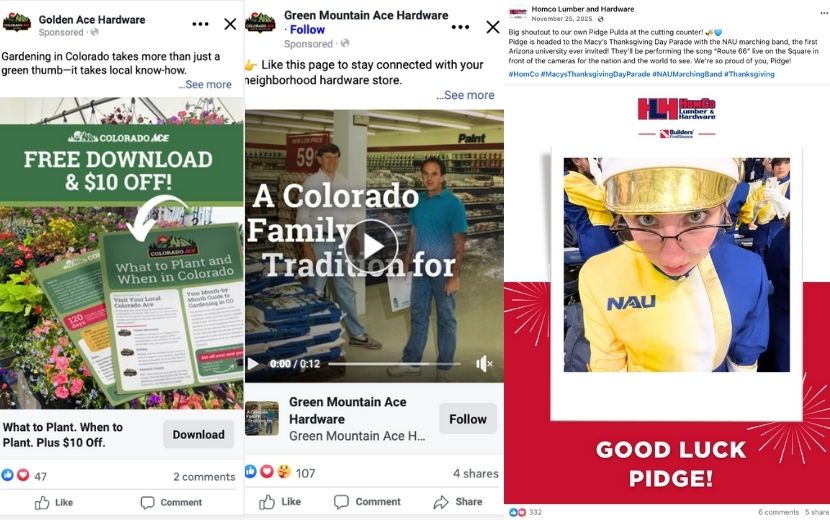
Click here to see some examples of our innovator’s top posts for 2025!
Takeaway #2: Having a Tough Time Getting Pictures of Completed Projects? Capture Them During the Parade of Homes!
Several marketers admitted the same challenge: getting photos of completed projects from sales teams or contractors is unreliable at best.
One innovator shared how they stopped waiting. Each year during their local Parade of Homes, they proactively go out and take photos themselves, not to claim the projects, but to highlight the types of materials they sell that show up in high-end builds.
This approach gave them a predictable source of visual content and removed the bottleneck of chasing photos internally.
Takeaway #3: Tell a Story on Social with Your Store’s Mascot: The Heartbreaking Tale of Rental Ron
One store leaned into a recurring character: a mannequin affectionately known in-store as “Rental Ron.” When the mannequin “retired” after losing a leg, the team didn’t let him go quietly into the night. They posted this funny photo of Rental Ron on a beach with a cast and kept their followers involved in his sad story.
What stood out to the group wasn’t the joke. It was the storytelling arc. The post worked because it gave people something to follow and remember. The group agreed that mascots, recurring jokes, or familiar in-store characters give marketers an ongoing narrative they can return to across seasons and campaigns.
Takeaway #4: 60/30/10 Rule: What to Post on Social & How Often
As marketers shared what worked (and what flopped), a clear pattern emerged. The issue wasn’t effort, creativity, or commitment. It was decision fatigue. Innovators described knowing they should post, but getting stuck trying to decide what deserves a spot in the feed and what doesn’t.
That’s why we put together these social media posting best practices for hardware retailers, which features the 60/30/10 framework to simplify the strategy:
- 60% Engaging Content: Focus on posts that entertain, educate, or inspire your audience.
- Example: “5 Essential Tools for Your First DIY Project.”
- Example: A time-lapse video of a deck built using your products.
- 30% Shared Content: Share relevant posts from other sources, such as industry news, community events, or partner businesses.
- Example: “Check out this handy guide to lawn care from our partners at GreenThumb Supplies!”
- 10% Promotional Content: Post about sales, special offers, or new products.
- Example: “Get 20% off all gardening tools this weekend only!”
Helpful Resources for Marketers
- Social Media Posting Best Practices for Hardware Stores
- Upcoming Webinar: Building a Practical Revenue Scorecard
- A few of our Innovators’ top posts of 2025:
Know another hardware store that would benefit from these insights? Share this recap with them!
Owner/General Manager Mastermind Takeaways:
Takeaway #1: Operational Resets Start with Personal Routines, Not Just Store Checklists
As the group talked through operational resets, it became clear that several GMs and owners are being intentional about protecting their own energy so they can lead better. One GM shared how starting their day earlier through a consistent “5 AM Club” routine helps them slow down, think more clearly, and be more deliberate once they’re in the store. That quiet time wasn’t about productivity hacks; it was about entering the day with intention instead of immediately reacting to problems.
Another GM described building in a full hour each day just for themselves, often leaving the store to eat lunch at home and mentally disconnect for a bit. What began as a practical change (cutting back on takeout) turned into a routine that helped them decompress and reset. The common thread across these examples was that making time for themselves wasn’t selfish. It was strategic.
By creating space to recharge, these leaders felt better equipped to be present, patient, and intentional with their teams throughout the rest of the day.
Takeaway #2: Delegation Creates Capacity, But It Also Changes Relationships
One innovator shared how delegating recurring leadership meetings to a strong HR leader freed them up to focus on higher-level work like marketing and planning. The shift helped Level 2 leaders feel more supported and accountable, since follow-ups were no longer falling back on the owner’s plate.
But there was a tradeoff. That same owner noticed their peer-style rapport with assistant managers had changed. Without the regular cadence of meetings, informal conversations faded. The takeaway wasn’t regret. It was awareness and growth around newfound freedom.
Delegation works, but leaders must intentionally replace the connection that used to happen naturally.
Know another hardware store that would benefit from these insights? Share this recap with them!
Join Us On February 18th for Our Next Mastermind
For February, we’ll have three groups that meet: B2B, Marketing, and GMs.
In the B2B Mastermind, we’ll focus on Strategic Customer Segmentation: Ranking & Scoring Commercial Accounts — digging into how innovators are evaluating their commercial customer lists, identifying which accounts deserve the most attention, and prioritizing time and follow-up based on real opportunity, not just gut feel.
In the Marketing Mastermind, we’ll dig into sales opportunities outside of Red Hot Buys, focusing on how to highlight everyday, high-margin products and promotions that don’t rely on vendor-driven pricing.
And in the Owners / General Managers Mastermind, we’ll focus on inventory ordering, discounting, and discontinuing, including how leaders are deciding what to double down on, what to clear out, and how to make those calls with more confidence heading into the rest of 2026.
Need help signing up? Join here!
Are You On Board?
Does the idea of a monthly meet-up with other retail hardware stores sound valuable? Would you like to share resources, ask questions, and participate with your peers on-demand through an exclusive Slack channel?
Email us at hello@hardwareinnovators.com to get access to the Slack Channel! The best part? It’s 100% free and puts you in touch with hardware store general managers, marketers, and B2B reps to ask questions and get immediate feedback from what worked at other hardware stores!